Your database may contain millions of records, but how much of it is accurate and reliable?
According to the 2025 Outlook: Data Integrity Trends and Insights report by Precisely, 76% of companies prioritize data-driven decision-making as their top objective. Yet, 67% don’t trust their data completely. This trust gap translates into delays in decision-making because you’re always waiting for “better data,” executives relying on their instincts rather than facts, and your teams wasting hours manually verifying information.
But why does this actually happen? The explanation goes further than simple data entry errors. Most in-house data mining teams struggle with things like limited expertise, staying compliant with regulations, keeping data consistent, and making different systems work together smoothly. The result is databases that seem complete but don’t help make clear and confident decisions.
This is where outsourcing data mining services turns out to be an effective solution. External teams bring expertise in data collection, processing, and analysis that most internal teams lack. With this approach, your business insights can finally be based on verified data rather than unreliable information.
In-House Data Mining: A Risky Bet for Most Organizations
Building an in-house data mining team might sound like you’re gaining control over the process. But, in reality, you’re just losing time, money, and in some cases, even competitive advantage. Here is how:
- Finding data professionals with niche skills for unstructured data mining is expensive and time-consuming. Retention is even harder as decent talent gets snapped up by tech-first firms.
- Data governance is now transnational, not just local. Most of the regulations, like the EU’s GDPR, China’s PIPL, Brazil’s LGPD, and updates in U.S. state-level rules, now overlap. In-house teams are often not equipped to navigate this complexity. This increases legal exposure and slows down the deployment of data.
- Data diversity and volume are growing faster than teams can keep up with. Modern companies gather behavioral, geospatial, sensor, and even conversational data. Internal teams struggle to handle the variety and speed of this data on a large scale. This challenge is especially true when analytics must be provided in near real-time across different regions.
- Time-to-insight is a competitive differentiator for companies. When internal resources handle data cleaning, enrichment, labeling, etc., it often results in bottlenecks that delay decision-making. This puts firms behind competitors with external, AI-optimized pipelines.
So, any failures arising from internal data mining initiatives aren’t just anomalies. They’re predictable outcomes of attempting to replicate specialized expertise in-house.
Why Are Data Mining Service Providers Outperforming Internal Teams?
Service providers eliminate the challenges associated with in-house teams while delivering superior results. The benefits of data mining service providers include:
- Specialized Expertise: Internal teams often learn through trial and error. On the other hand, service providers come with proven experience in similar projects. They’ve seen and handled most of the data quality issues and integration challenges that stop projects from reaching their final stage.
- Access to Web Scraping Infrastructure: Most in-house teams are required to build or purchase data extraction and processing tools. But service providers already have access to these tools. They can even utilize APIs, custom web crawlers, and automated extraction scripts to mine data.
- Established Workflows: Your internal team might spend months figuring out the right processes. On the contrary, service providers already have clear and repeatable workflows. This means they can start new projects quickly and keep everyone informed, even if the team members change.
- Scalability to Match Business Needs: Internal teams are forced to hire more people when workload increases or consider layoffs when demand declines. This creates operational instability for companies. On the other hand, service providers adjust resources depending on project demands. For you, this reduces the overhead costs of maintaining a permanent team.
- Secure Data that Meets Applicable Compliances: Companies need to invest in compliance training, monitoring, and audits to keep their teams updated on changes in regulations like GDPR, CCPA, and HIPAA. Service providers cover this concern with dedicated teams who receive regular training.
How Outsourcing Data Mining Services Helps You Get Better Insights
Simple! They have perfected the process that your in-house team is just beginning to explore.
Outsourcing data mining services offers many benefits—a team of professionals, advanced data mining capabilities, and faster results. But such companies get you the right results because they have established a workflow and can tailor it to match your needs. In this case, with a streamlined, end-to-end process—from data collection and cleaning to analysis—it becomes easier and faster to uncover trends, behaviors, and opportunities that might otherwise be missed.
To convert complex and unstructured data into valuable insights for the business, most service providers follow a five-step approach to the process, as explained below:
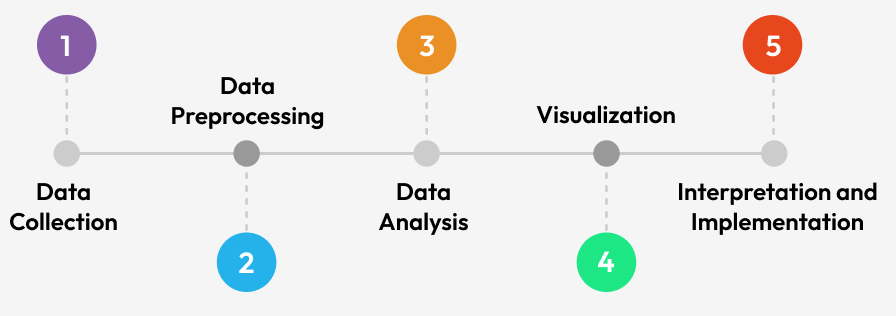
1. Data Collection
The process of data mining begins with pinpointing the most relevant data sources as per your business requirements. These sources could include:
- Your internal data (such as sales transactions, customer information, and operational logs)
- External sources (competitor websites, social media platforms, market reports, and industry databases for B2B data mining)
Once these sources are chosen, the next step is to collect the data. Data mining experts use tools like web scraping, API integrations, and data extraction software to gather all the needed information.
2. Data Preprocessing
No matter how carefully you collect the data, it can still have problems like the same information in multiple fields (John Rover, J. Rover), different formats (9-June-2025, 09/06/25, 09/06/2025, 06/09/2025), partial data (email is present, but phone number isn’t), or a typo (age – 250.)
This step is all about cleaning things up—fixing those formatting issues, removing duplicates, and making sure the data is consistent and ready to be analyzed.
3. Data Analysis
Experts look for patterns and trends to identify challenges and opportunities for your business. They use techniques like statistical models, time-series analysis, and clustering for the same. This means you get ready-to-use information, and you don’t need to do any extra analysis yourself.
4. Data Visualization
Most executives don’t have the time to skim through multiple pages of textual information. What do they then rely on? Interactive dashboards, predictive charts, and executive summaries that highlight key findings and their business implications. By outsourcing data mining services, you get the help of professionals to translate analysis into the right type of charts and dashboards that best fit your data so that stakeholders can quickly grasp the information.
5. Interpretation and Implementation
Finally, the process of data mining ends with turning the analyzed data into clear recommendations and action plans. This provides answers to questions like
- Which segments of the buyers should you target for personalized offers?
- What market updates and trends should you prepare for to stay competitive?
- What processes can be improved to increase efficiency and reduce costs?
Stop Waiting, Start Winning: Your Data Mining Action Plan
The path forward requires honest assessment: Can your internal team match the specialized expertise, regulatory knowledge, scalability, and infrastructure that outsourcing data mining services helps with? For most organizations, the answer can reveal uncomfortable truths about their resource limitations. So, stop measuring success by what you build internally. Start measuring it by the insights you generate and the decisions you can make confidently with a third-party data mining company.